
 Professor Kathryn Henne, Director of the ANU School of Regulation and Global Governance (RegNet).
Thanks to its strong reputation as a balanced regulator, Australia could play a key role in managing AI’s risk and opportunities. For Kathryn Henne, Professor and Director of the ANU School of Regulation and Global Governance (RegNet), Australia has a record of fearlessly managing crises and taking the lead while being sound financial managers. How the Australian Government approaches AI regulation, though, is still taking shape.
“Australia is known for regulatory innovation,” she said. “We’re not the EU, China, or USA, but Australia is uniquely equipped to support and pilot different regulatory models. We have strong relationships in Asia and the Pacific to cultivate and think critically about regulatory needs, especially as countries are moving toward creating sovereign AI in their jurisdictions. Australia is a good middle power and a good neighbor.”
Henne leads the ANU Justice and Technoscience Lab (JusTech). Her research is concerned with how science and technology contribute to the governance of health, public safety, and well-being. Her publications span diverse areas such as automated decision-making, biomedicine, data governance, gender inclusion, health promotion, social protection, and surveillance.
“We established the lab in 2019 to support students who were really concerned about emerging technologies with unintended consequences and harms,” Henne continued. “We’re agnostic to the individual technology.”
These emerging technological areas include artificial intelligence, climate finance, digital public infrastructure, and neurotechnologies. Her team looks at what policymakers haven’t anticipated and shed light on lived experiences of those impacted to improve governance for these spaces.
Presenting risks and harms to practitioners
There is a plethora of research that tries to understand bias and discrimination in algorithms and models. In addition to conducting their own empirical studies of lived experience, Henne and her team synthesize that research to present to policymakers and engineers, who may not be trained to appreciate different harms.
“A lot of our work is to translate that for those without social science backgrounds,” she said. “Our work is not only about identifying, but also about translating so that people can improve sociotechnical design. We try to make sure civil society is involved and bolster the work done by social science researchers.”
When Henne was first studying tech regulation, the topic was not in vogue. With the rise of AI, society at large recognizes its importance, with increasing advocacy for different levels of regulation. Some push for softer laws that aim to support flexibility to enable innovation, leaving the industry mostly self-regulated. Others see more pressing risks and call for more formal regulation such as the EU. Henne and her team have worked on both types of regulation, including co-developing a taxonomy to help practitioners better identify and anticipate algorithmic harms.
| “ |
“One of the challenges of this space is that we are really good at identifying certain kinds of acute risk, but less equipped to identify systemic issues that might seem minor but at scale could cascade and have broad negative impacts.”
“One of the challenges of this space is that we are really good at identifying certain kinds of acute risk, but less equipped to identify systemic issues that might seem minor but at scale could cascade and have broad negative impacts,” Henne said. “There are also opportunities to learn from other safety-critical industries like aviation to figure out how to incentivize best practices or when and how we should pause things.”
While self-regulation is growing, Henne believes that approach is only effective in industries with settled norms and values and where there is agreement on the need to prevent harms. A governmental or third-party actor is often needed to enact sanctions to keep those norms in place. This does not yet exist in the AI space.
“There’s also the danger of ritualism. That is, policy that looks great and says what to do, but actual practice doesn’t follow through on it,” she said.
An early interest in understanding disparities
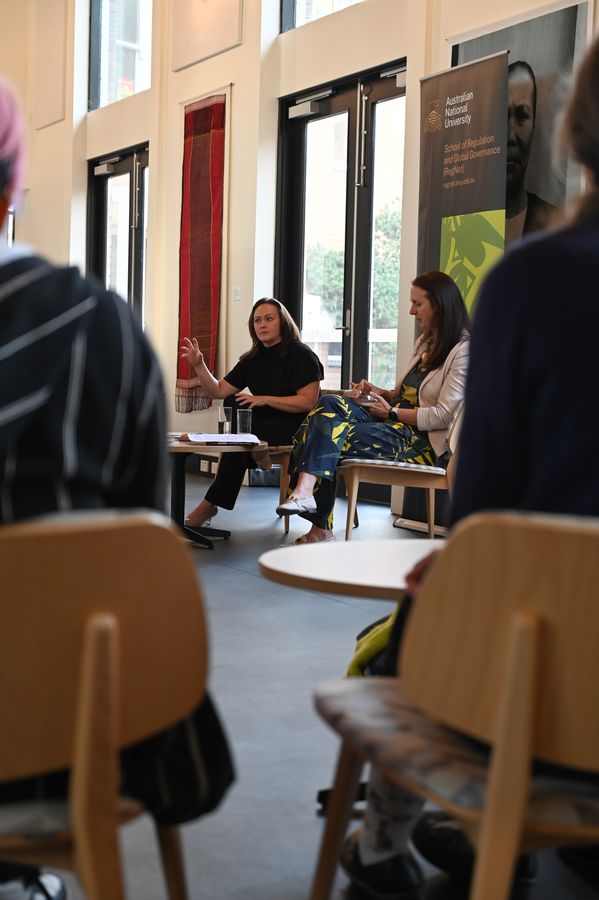 Henne at a launch event at the ANU for her book, Violent Impacts: How Power and Inequality Shape the Concussion Crisis.
Henne’s interest in the relationships between inequality, technology, and regulation stems in part from her childhood in a small town in Pennsylvania which had one of the largest landfills in the United States only five hundred meters from her house.
As a small, comparatively poor town with great ethnic diversity, there were many forms of segregation and damaging industry practices that government intervention rarely addressed. She saw different impacts on different racial groups, which led to an interest in how to explain the disparity. The surrounding area now has large solar panel and datacenter buildouts, continuing to provoke discussions of stakeholder impact and inequities to this day.
“I’ve gone back to do research to see how people are understanding these issues,” she said. “If we’re going to generate knowledge about these issues, I want to make sure that knowledge can be shared and that we value the knowledge of people who are experiencing the impacts of technological developments.”
You may also like
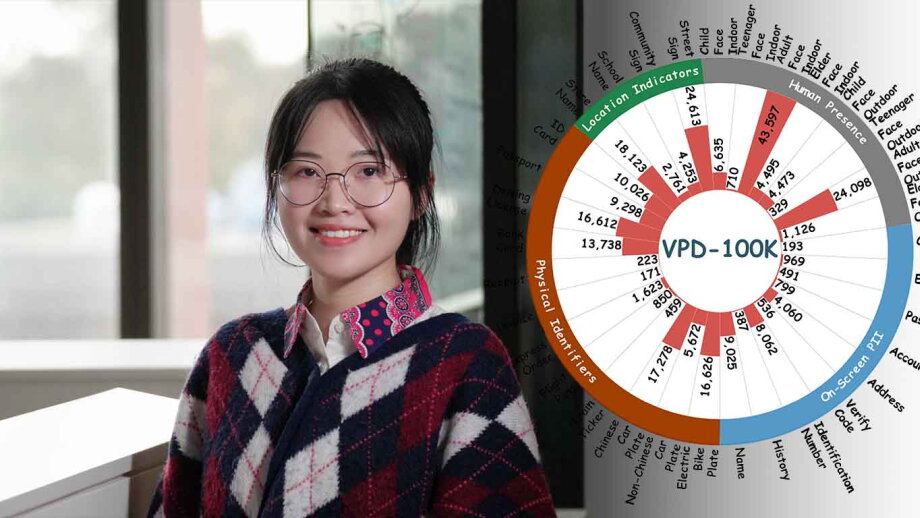
A deeper understanding of software and privacy leads to a secure future
Dr Xiaoyu Sun discusses software and privacy spanning bug detection, deployment reliability, and the VPD-100k visual privacy dataset unveiled at ICML.
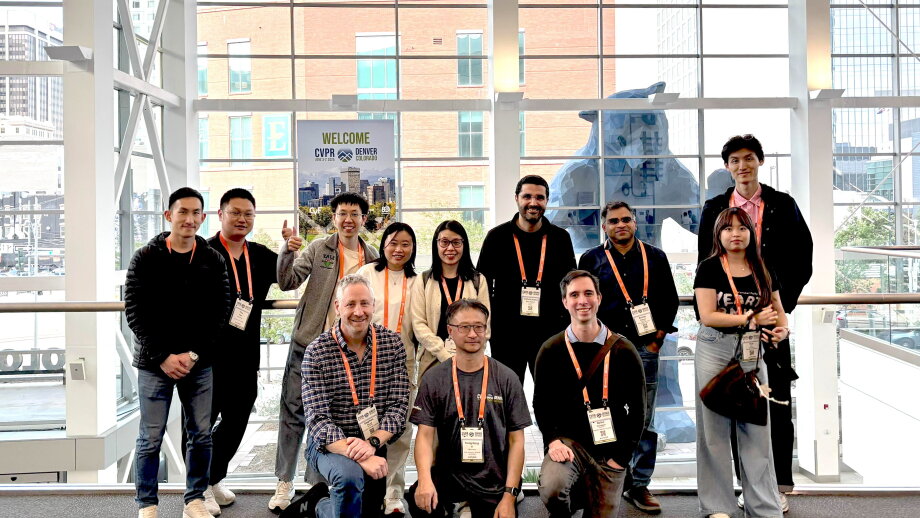
ANU Computer Vision Researchers Shine Again at CVPR 2026
Building upon decades of research excellence, ANU computer vision researchers, students, and alumni achieved major awards and acceptances at IEEE CVPR 2026.
Cybersecurity expert protects democracy through academic independence
Dr Thomas Haines discusses how cryptography, cybersecurity, and academic independence safeguard democratic elections.